When Recognition Is Replaced: What “Nuclear Family Month” Really Signals
Renaming June isn’t neutral. It’s a signal. This blog breaks down Tennessee’s “Nuclear Family Month” move, the history behind similar tactics, and why visibility isn’t just symbolic, it’s power.
The Bottom
4/21/20263 min read
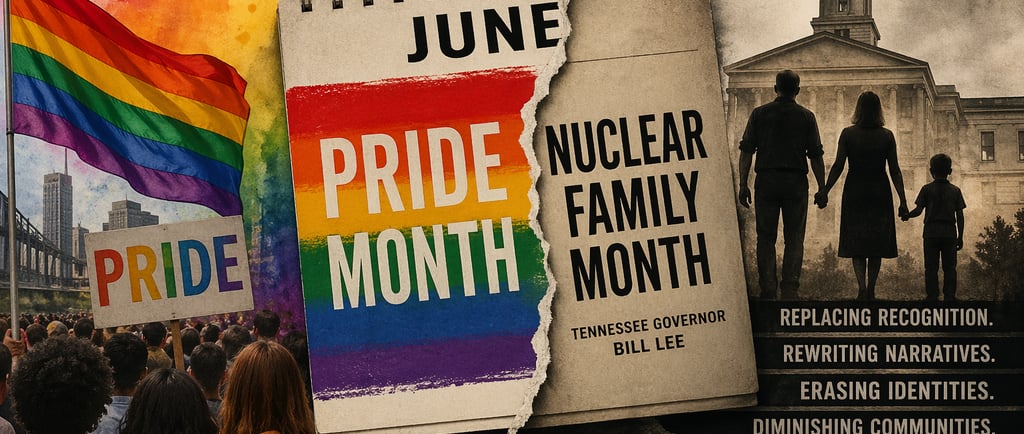
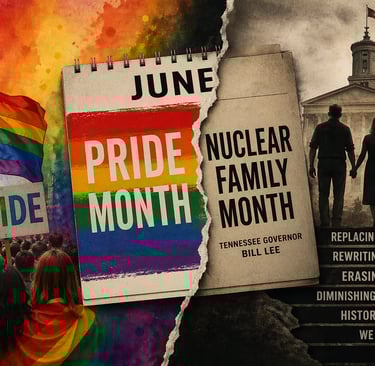
Just last week Tennessee Governor Bill Lee signed a proclamation designating June as “Nuclear Family Month."
On its surface, that might sound harmless. A celebration of families. Stability. Tradition.
But June is not an empty space on the calendar. For decades, it has been nationally and culturally recognized as Pride Month, a time set aside to honor LGBTQ+ history, visibility, resilience, and progress.
So when a state formally rebrands that same month with a different value system, it is not neutral. It is not additive. It is a replacement. And replacement, in this context, has a long and very specific history
This Isn’t New. It’s a Pattern
Governments and institutions have often used symbolic moves like this to reshape public perception without explicitly banning or outlawing a group. Instead of direct confrontation, the tactic is quieter: redefine the narrative, elevate one identity, and implicitly push another out of view.
We have seen this before.
In the late 19th and early 20th centuries, Indigenous cultures across the United States were not only physically displaced but culturally erased. Language bans in boarding schools, the renaming of traditions, and the elevation of “American” norms over Native identity were all framed as efforts to “civilize” or “unify.” The result was not unity. It was generational trauma and the loss of cultural continuity that communities are still working to reclaim today.
During the Jim Crow era, Black contributions, achievements, and histories were systematically excluded from textbooks, public narratives, and civic recognition. It was not just about segregation in physical spaces. It was about controlling what was visible, what was celebrated, and ultimately, what was considered valuable. When you erase visibility, you limit opportunity. When you limit opportunity, you constrain success.
Even women’s history followed a similar trajectory. For years, the absence of recognition in education and public life reinforced the idea that women’s contributions were secondary or insignificant. It took decades of advocacy just to carve out designated space, such as Women’s History Month, to correct that imbalance.
In each of these cases, the tactic was not always loud. It did not always announce itself as erasure. But the effect was the same.
Visibility Is Not Just Symbolic
Recognition months are often dismissed as performative or unnecessary. But visibility has real, measurable impact.
When a community is visible:
Its history is taught.
Its contributions are acknowledged.
Its members are more likely to see themselves as belonging and capable.
When that visibility is diminished or replaced:
Narratives narrow.
Representation fades.
Belonging becomes conditional.
For LGBTQ+ communities, Pride Month has never been just a celebration. It is a marker of survival. It exists because visibility was once dangerous, and in many places, still is.
Replacing that visibility with a state-endorsed emphasis on a single definition of family does more than celebrate one group. It signals which identities are prioritized and which are being pushed to the margins.
The Framing Matters
It is worth paying attention to language here.
“Nuclear family” is not a neutral term. It refers to a very specific structure: typically heterosexual, married parents and their biological children. By elevating this model as the one worthy of recognition in June, the implication is clear. Other family structures exist, but they are not the focus. They are not the standard being celebrated.
That includes single-parent households, extended families, chosen families, and yes, LGBTQ+ families.
And chosen family, in particular, is central to many LGBTQ+ lives. It has been a source of support, safety, and survival when biological families were not.
So when the state elevates one model during a month historically dedicated to LGBTQ+ identity and community, it is difficult to interpret that as coincidence.
The Impact Over Time
Moves like this rarely have immediate, dramatic consequences. Their power is cumulative.
They shape:
What gets taught in schools
What is considered “normal”
Which communities feel supported by their government
Which young people see a future for themselves where they are
Over time, these signals influence policy, funding, and cultural attitudes. They create an environment where exclusion can grow, even if it is not explicitly stated.
History shows us that when communities are pushed out of visibility, their access to opportunity, safety, and success often follows.
What This Moment Asks of Us
This is not just about a proclamation. It is about how we respond to it.
We can choose to recognize the pattern for what it is. We can push back on the idea that visibility is a zero-sum game. We can continue to make space, loudly and intentionally, for communities whose presence is being minimized.
And we can remember that recognition matters, not because it is symbolic, but because symbols shape reality.
Pride Month was never about asking for permission to exist. It was about asserting that existence, openly and without apology.
That does not change because a calendar does.